Straight To The Point -» no hype, no detours #4
When Architecture Determines Pricing Power
STTP Group
1/6/20262 min read
Executive Summary
European telecom prices have broadly fallen or remained stable, even as investment needs climb.
Complexity in BSS/OSS and inability to enact rapid pricing/product change forces operators to rely on pricing levers instead of structural competitiveness.
Up to 72% of 5G monetization opportunities depend on OSS/BSS transformation.
Sustainable margin protection comes from architectural agility and standards‑aligned execution, not short‑term cost cutting.
Falling Prices Mask Rising Structural Costs
Contrary to popular narrative, average broadband prices in five of six major European markets decreased between 2023–2025, led by double‑digit declines in Spain (‑11.6%) and the Netherlands (‑11.0%) (Source: Tarifica)
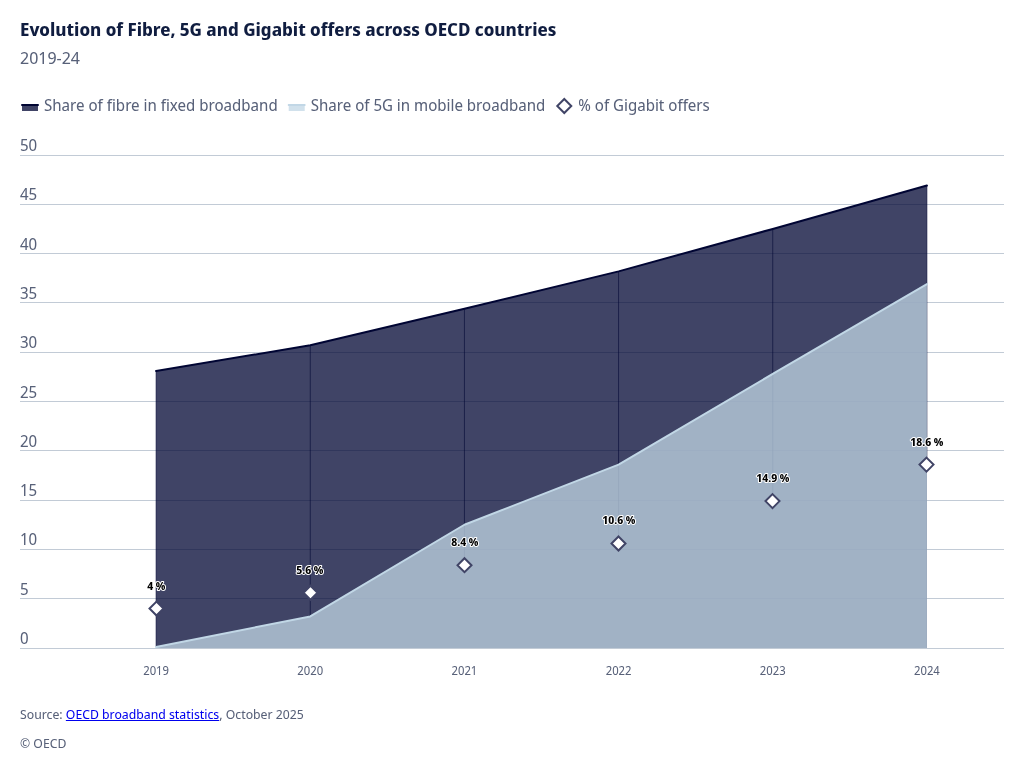
At the same time, demand for high‑speed connectivity is not slowing: gigabit broadband offers have grown nearly fivefold over five years in OECD markets, as digital usage and 5G penetration accelerate.
This dichotomy—price deflation for end users but cost inflation for operators—means that telecoms increasingly must justify higher prices only where legacy systems restrict agility.
Consumers are sensitive to annual tariff changes: a recent EY study found 57% of households globally worried about broadband price increases, and 41% say cost savings drive plan switching. (Source: EY)
In this environment, reliance on pricing as a short‑term lever—especially where internal change cycles are slow—is less a strategic choice and more a structural outcome of rigid BSS/OSS and aging product stacks.
Complexity Equals Cost
Across European operators, legacy system complexity manifests as:
Delayed pricing revisions taking months, not weeks
Product launches blocked by brittle integrations
Manual workarounds for compliance and revenue reporting
Distributed data systems with poor operational insight
Execution delays compound because most transformation funding goes to “keeping the lights on,” not creating architectural exit velocity. The result is that pricing becomes the default lever, eroding strategic options and customer trust.
In telecommunications, as in energy and banking, this pattern is visible:
Energy players struggle to support complex tariff models and integration of volatile commodity pricing engines
Financial institutions confront similar rigidity in risk, fraud, and customer lifecycle systems
In all these sectors, structural complexity limits an organization’s ability to compete on value and innovation.
Standards Are Necessary but Not Sufficient
Telecoms have embraced frameworks such as TM Forum Open Digital Architecture (ODA), but standards alone do not deliver outcomes. Value accrues only when standards become operational reference models that guide implementation, governance, testing, and adoption.
Evidence from TM Forum suggests up to 72% of revenue growth from advanced 5G services depends on OSS/BSS transformation, not infrastructure alone. Source(tmforum.org)
Standards articulate what good looks like, but execution architectures and delivery governance define how to get there. Too often, the gap between aspiration and execution is measured in months of delay and significant operational overhead.
Agility, Not Austerity
Forward‑leaning operators shift focus from cutting expenses toward architectural agility:
Decoupling core systems from innovation layers
Introducing modular, API‑centric BSS/OSS
Building governed data platforms as the foundation for pricing, CRM, and risk workflows
Embedding automation within controls, not around them
These patterns reduce the reliance on pricing adjustments as the only mechanism for margin preservation.
This is not a purely telecom phenomenon:
In energy markets, advanced pricing engines absorb market volatility without forcing abrupt tariff hikes
In financial services, governed data and analytics platforms enable dynamic risk pricing and fraud detection
Across industries, leaders are turning standards into structured delivery frameworks—and architectural rigidity into competitive advantage.
The Real Executive Imperative
The critical leadership question is no longer:
“How do we reduce costs?”
but rather:
“How much complexity can our architecture sustain before pricing becomes our only lever?”
Organizations that answer this with deliberate investment in standards‑to‑execution architecture, delivery discipline, and operational governance will protect margins and unlock new revenue pathways.
Those that do not will continue to justify price increases to customers, regulators, and markets.